Save on this course — limited-time offer available
  • UK's leading online learning provider
  • Expert tutor support included
  • Learn at your own pace, 24/7 access

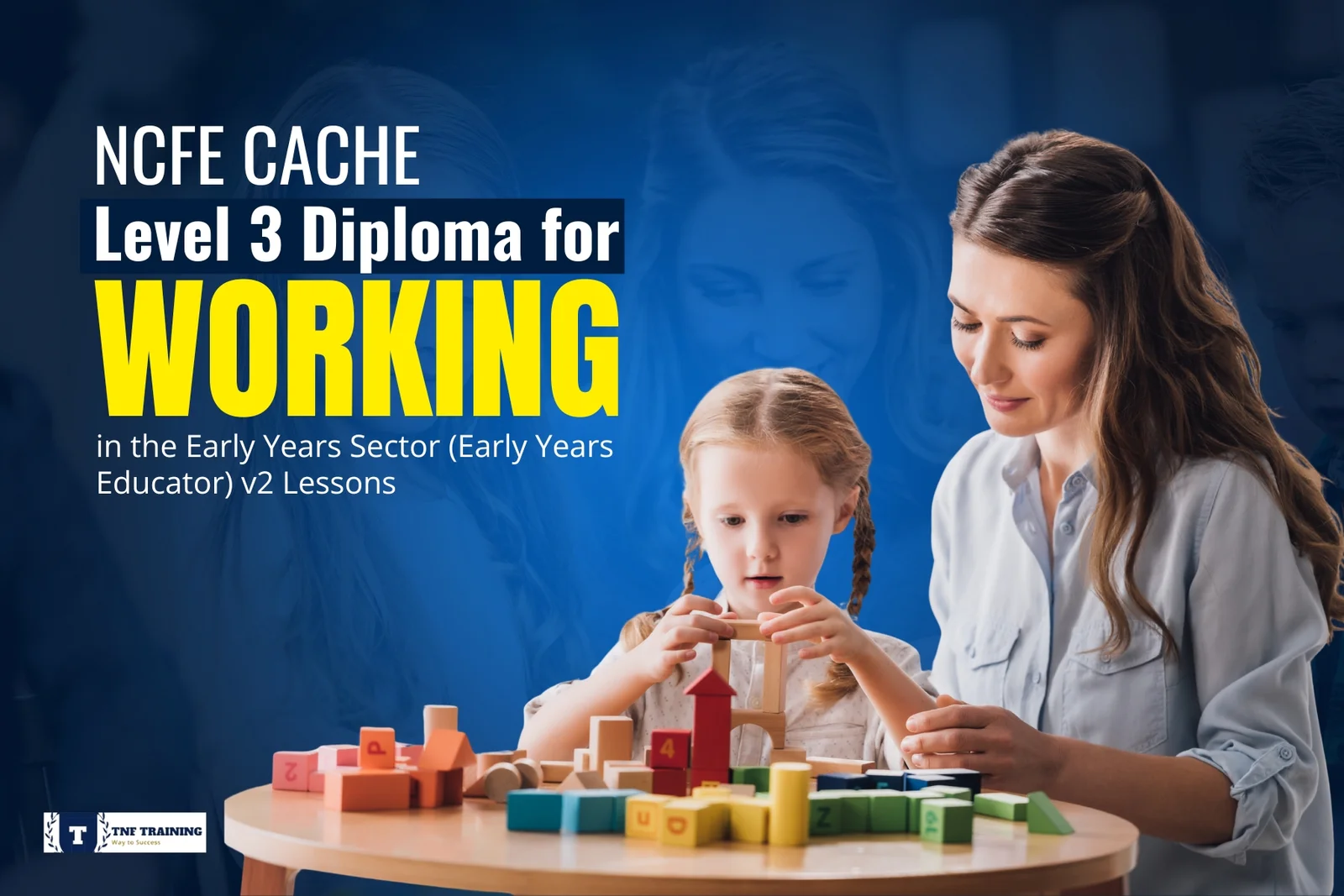
NCFE CACHE Level 3 Diploma for Working in the Early Years Sector (Early Years Educator) v2 Lessons

About CourseThis qualification is designed to prepare learners to work as early years educators, supporting children’s learning, development and well-being from birth up to age 5, with knowledge also extending to childre...
  • Super admin image

    By - Super admin

  • 1 students
  • 180 Hours
  • (0)

Get in touch and we'll call you back

NCFE CACHE Level 3 Diploma for Working in the Early Years Sector (Early Years Educator) v2 Lessons
Recommended option

Flexible payment options — get tutor support and full course access

NCFE CACHE Level 3 Diploma for Working in the Early Years Sector (Early Years Educator) v2 Lessons

This course at a glance

After completing this course:
  • NCFE CACHE Level 3 Diploma for Working in the Early Years Sector (Early Years Educator)
  • Eligible for Level 3 staff-to-child ratios (DfE criteria)
  • Progression to Level 5 early years senior practitioner roles

About CourseThis qualification is designed to prepare learners to work as early years educators, supporting children’s learning, development and well-being from birth up to age 5, with knowledge also extending to childre...

Course Requirements

  • Level 2 early years qualification or substantial experience
  • Employment in a registered early years setting
  • GCSE English and maths at grade C/4 or above (or equivalent)
  • DBS check required

Course Description

About Course

This qualification is designed to prepare learners to work as early years educators, supporting children’s learning, development and well-being from birth up to age 5, with knowledge also extending to children up to age 7. On successful completion, learners will be eligible to count in the Level 3 staff-to-child ratios in early years settings, meeting the criteria set by the Department for Education (DfE).

Course Outcomes

After completing this course:
  • NCFE CACHE Level 3 Diploma for Working in the Early Years Sector (Early Years Educator)
  • Eligible for Level 3 staff-to-child ratios (DfE criteria)
  • Progression to Level 5 early years senior practitioner roles

Explore the modules and lessons included in this course.

Course Curriculums

  • 10 chapters
  • 104 lectures
  • 0 quizzes
  • 180 Hours total length
Toggle all chapters
1 Start
N/A


2 Understand the professional roles and responsibilities required to work in an early years setting (EYEL3WF1-1).
N/A


3 https://thetnftraining.co.uk/courses/ncfe-cache-level-3-diploma-for-working-in-the-early-years-sector-early-years-educator-v2-lessons/#:~:text=Understand%20procedures%20that%20must%20be%20adh
N/A


4 Understand the role of supervision (EYEL3WF1-3).
N/A


5 Understand professional development (EYEL3WF1-4).
N/A


6 Be able to use and model good communication skills, including a good command of the English language in spoken and written form (EYEL3WF1-5).
N/A


7 Be able to explain own role, responsibilities and expected behaviours, and the roles of colleagues in the setting and team (EYEL3WF1-6).
N/A


8 Be able to explain how our own and others’ behaviour can impact on babies and children and the importance of role modelling positive behaviours (EYEL3WF1-7).
N/A


9 Be confident in supporting or challenging the practice of colleagues, including difficult conversations (EYEL3WF1-8).
N/A


10 Be able to follow procedures in the work setting, including, where appropriate, updating and developing policies and procedures (EYEL3WF1-9).
N/A


11 Be able to foster a culture of mutual support, teamwork and continuous improvement that encourages confidential discussion of sensitive issues, through effective supervision at all stages of
N/A


12 Be able to seek out feedback from others and use reflection to identify and support career development and personal goals (EYEL3WF1-11).
N/A


1 Understand theories of play and its fundamental role in learning and development (EYEL3WF9-1).
N/A


2 Understand the significance of play for learning and development (EYEL3WF9-2).
N/A


3 Understand play at different stages of babies’ and children’s development (EYEL3WF9-3).
N/A


4 Understand different types of play for all children (EYEL3WF9-4).
N/A


5 Understand inclusive play practice (EYEL3WF9-5).
N/A


6 Be able to plan, lead and evaluate play opportunities in an early years setting (EYEL3WF9-6).
N/A


7 Be able to lead and support inclusive play experiences (EYEL3WF9-7).
N/A


8 Be able to apply theoretical perspectives and philosophical approaches in planning play opportunities (EYEL3WF9-8).
N/A


1 Understand the role of assessment in helping parents, carers and educators recognise children’s progress (EYEL3WF8-1).
N/A


2 Understand that there are different assessment methods and techniques, which inform what we know about children’s progress and the planning cycle (EYEL3WF8-2).
N/A


3 Understand the role of the early years educator for effective and accurate, proportionate assessment (EYEL3WF8-3).
N/A


4 Understand the key stages in assessing children’s progress (EYEL3WF8-4).
N/A


5 Be able to discuss children’s progress and plan the next stages in their learning with the key person, colleagues, parents or carers (EYEL3WF8-5).
N/A


6 Be able to use information from assessment to adjust curriculum and plans so that any gaps in children’s learning are addressed, supporting the child’s development (EYEL3WF8-6).
N/A


7 Be able to carry out assessment effectively, plan and record the outcomes, and share results accurately and confidentially in line with the early years foundation stage (EYFS) statutory frame
N/A


1 Understand how evidence-based philosophical and pedagogical approaches influence the early years foundation stage (EYFS) that sets out the early education curriculum requirements from birth t
N/A


2 Understand that all children and young people are entitled to an education, appropriate to their needs, which promotes high standards and the fulfilment of potential (EYEL3WF7-2).
N/A


3 Understand how the curriculum and pedagogical approaches to teaching are planned and adapted to create experiences and opportunities for children which appreciate that children are likely to
N/A


4 Understand that a carefully planned and sequenced curriculum is essential for all children, in recognition of their needs and interests, to include adult-led explicit teaching, as well as chi
N/A


5 Understand that the learning environment, both indoors and outdoors, is a resource that supports the implementation of the curriculum (EYEL3WF7-5).
N/A


6 Promote equality of opportunity in the education and care of all children in early years provision, including children with special educational needs and disabilities (SEND) (EYEL3WF7-6).
N/A


7 Be able to plan educational programmes that reflect the needs and interests of the children (EYEL3WF7-7).
N/A


8 Be able to use appropriate curriculum and practice support, such as the nonstatutory Development Matters guidance (EYEL3WF7-8).
N/A


9 Be able to respond to the needs and interests of the child, to support intended learning (EYEL3WF7-9).
N/A


10 Be able to reflect on the impact of pedagogical approaches and values on the environment in an early years setting (EYEL3WF7-10).
N/A


11 Be able to select and combine the best pedagogical approaches, based on the curriculum and children’s prior knowledge (EYEL3WF7-11).
N/A


12 Be able to adapt teaching to suit babies’ and children’s different starting points, experience and knowledge (EYEL3WF7-12).
N/A


1 Understand legal requirements and statutory guidance, as well as other nonstatutory guidance on health and safety (EYEL3WF6-1).
N/A


2 Understand it is important to ensure equipment, furniture and materials are used safely and the dangers of not doing so (EYEL3WF6-2).
N/A


3 Understand the role of policy and procedure in maintaining the health, wellbeing and safety of babies and children (EYEL3WF6-3).
N/A


4 Understand that it is important to prevent and control infection (EYEL3WF6-4).
N/A


5 Understand the signs and symptoms of a child who is unwell or injured (EYEL3WF6-5).
N/A


6 Understand that it is important for babies and children to have a healthy, balanced and nutritious diet (EYEL3WF6-6).
N/A


7 Understand that it is important for babies and children to be physically active (EYEL3WF6-7).
N/A


8 Understand the importance of risk versus benefit (EYEL3WF6-8).
N/A


9 Be able to use equipment, furniture and materials safely following the manufacturer’s instructions and setting’s requirements, with regard for sleep safety. Assist others in the safe use of:
N/A


10 Be able to identify and act upon own responsibilities in relation to: health, safety, wellbeing (EYEL3WF6-10).
N/A


11 Be able to carry out risk assessments and risk management in line with: employer, local and national requirements, policies and procedures (EYEL3WF6-11).
N/A


12 Be able to maintain accurate and coherent records and reports and share information, when appropriate, to ensure the needs of all children are met (EYEL3WF6-12).
N/A


13 Be able to explain, plan, and carry out respectful care routines appropriate to the development, stage, dignity and needs of babies and children, to include their cultural, race, religion and
N/A


14 Be able to implement effective strategies for preventing and controlling infection (EYEL3WF6-14).
N/A


15 Be able to take appropriate action to respond to accidents and emergency situations (EYEL3WF6-15).
N/A


16 Be able to share information with parents and carers (EYEL3WF6-16).
N/A


1 Understand the signs of harm and the different types of abuse and what these are (EYEL3WF5-1).
N/A


2 Understand legislation, policies and procedures in relation to keeping children safe (EYEL3WF5-2).
N/A


3 Understand an early years educator’s role and responsibilities in relation to keeping children and colleagues safe (EYEL3WF5-3).
N/A


4 Be able to recognise when a baby or child is in danger or at risk of abuse, including online, and know how to act to protect them (EYEL3WF5-4).
N/A


5 Be able to find and stay updated on employer, local and national safeguarding policies and procedures, as set out in statutory and non-statutory guidance (EYEL3WF5-5).
N/A


6 Be able to follow Ofsted’s whistleblowing policy to pass on information that, where it is reasonable to believe, shows wrongdoing or a cover-up by an employer’s organisation (EYEL3WF5-6).
N/A


7 Be able to carry out own role and act upon responsibilities, including providing appropriate supervision of others in relation to safeguarding and security, including child protection, duty o
N/A


1 Understand the impact of an effective communication and language curriculum that offers positive benefits to babies and children’s development (EYEL3WF4-1).
N/A


2 Understand that children develop at their own pace in language development and can experience speech and language difficulties (EYEL3WF4-2).
N/A


3 Understand that there are ways to communicate with all children, appropriate for their stages of development (EYEL3WF4-3).
N/A


4 Be able to develop, support and promote babies’ and children’s speech, language, and communication through effective planned adult interactions (EYEL3WF4-4).
N/A


5 Be able to identify delays in communication development and describe appropriate support services for babies and children (EYEL3WF4-5).
N/A


6 Be able to communicate with all children in ways that will be understood, including verbal and non-verbal communication, to extend their learning and development (EYEL3WF4-6).
N/A


7 Be able to help children catch up with language development through planned use of pronunciations, words and phrases (EYEL3WF4-7).
N/A


8 Be able to adapt teaching approaches, as appropriate, to ensure children with speech and language difficulties, and those for whom English is an additional language (EAL), are supported to ca
N/A


9 Be able to apply a range of communication methods for effective collaborative working (EYEL3WF4-9).
N/A


1 Know about legislation and guidance for children and young people with special educational needs and disabilities (SEND) (EYEL3WF3-1).=
N/A


2 Understand that there are appropriate strategies for supporting a baby or child with SEND (EYEL3WF3-2).
N/A


3 Understand that there are specialist aids, resources, and equipment available to support babies and children with SEND (EYEL3WF3-3).
N/A


4 Be able to explain and apply the early years foundation stage (EYFS) statutory framework and SEND code of practice in relation to the care and education of babies and children with SEND, thro
N/A


5 Be able to work effectively in partnership with others (or alongside colleagues), including parents and carers, to promote and implement appropriate strategies for supporting the progress of
N/A


6 Be able to effectively carry out a child’s care plan (or shadow a colleague) alongside parents and carers, including the initial assessment, implementation, and ongoing review (EYEL3WF3-6).
N/A


7 Be able to promote and encourage a working environment that values and respects the individual developmental needs and stages of babies and children with SEND (EYEL3WF3-7).
N/A


8 Be able to use specialist aids, resources and equipment available to support babies and children with SEND (EYEL3WF3-8).
N/A


9 Be able to analyse and explain how cultural background and family circumstances can impact on babies’ and children’s learning and development (EYEL3WF3-9).
N/A


1 Understand the expected patterns of babies’ and children’s development from conception to seven years old (EYEL3WF2-1).
N/A


2 Understand key milestones for holistic development from birth to seven years (EYEL3WF2-2).
N/A


3 Understand the influence of key individuals and the importance of attachments that shape babies’ and children’s social world and underpin their holistic learning and development (EYEL3WF2-3).
N/A


4 Understand the significance of physical, mental and emotional health and wellbeing for babies’ and children’s development (EYEL3WF2-4).
N/A


5 Understand coregulation and self-regulation in children (EYEL3WF2-5).
N/A


6 Understand a range of evidence-based theories and research that underpin early years development (EYEL3WF2-6).
N/A


7 Be able to prepare and support babies and children through transitions and significant events in their lives (EYEL3WF2-7).
N/A


8 Be able to support children to form positive attachments (EYEL3WF2-8).
N/A


9 Be able to promote health and wellbeing in settings working with babies and children from birth to five years (EYEL3WF2-9).
N/A


10 Be able to support children to develop a positive sense of self and to recognise, understand and manage their emotions, including supporting a child’s understanding of differing emotional rea
N/A


11 Be able to apply evidence-based theories in practice, and as appropriate, based on a clear understanding of cognitive science (reliable theory) (EYEL3WF2-11).
N/A


1 Understand the importance of developing and maintaining good relationships and partnerships in an early years setting (EYEL3WF10-1).
N/A


2 Understand the significance of parent and carer engagement (EYEL3WF10-2).
N/A


3 Understand how to build and sustain relationships with all parents and carers (EYEL3WF10-3).
N/A


4 Understand the importance of professional relationships with colleagues, other organisations, and agencies in working with and supporting early years settings and children (EYEL3WF10-4).
N/A


5 Understand that setting leaders need to collaborate and work with colleagues and other relevant professionals within and beyond their setting to ensure babies and children progress well in th
N/A


6 Understand that it is important to be an advocate for babies and children (EYEL3WF10-6).
N/A


7 Understand that Ofsted is responsible for the regulation and inspection of early years provision (EYEL3WF10-7).
N/A


8 Be able to work in partnership with parents and carers to help them recognise and value the significant contributions they make to the child’s health, wellbeing, and learning and development
N/A


9 Be able to encourage parents and carers to take an active role in their baby’s or child’s care, play, learning and development (EYEL3WF10-9).
N/A


10 Be able to explain the roles and responsibilities of other agencies and professionals that work with and support the setting and children, both statutory and non-statutory, and be familiar wi
N/A


11 Be able to work co-operatively and communicate effectively with key persons, colleagues, other professionals, and agencies to meet the needs of babies and children and enable them to progress
N/A


12 Be able to make additional provisions to support babies’ and children’s education and development where they lack this support from parents and carers (EYEL3WF10-12).
N/A


13 Be able to work confidently with the Ofsted early years inspection framework (EYEL3WF10-13).
N/A


Instructor

Super admin

As the Super Admin of our platform, I bring over a decade of experience in managing and leading digital transformation initiatives. My journey began in the tech industry as a developer, and I have since evolved into a strategic leader with a focus on innovation and operational excellence. I am passionate about leveraging technology to solve complex problems and drive organizational growth. Outside of work, I enjoy mentoring aspiring tech professionals and staying updated with the latest industry trends.

0 Rating
0 Reviews
9 Students
46 Courses

Course Full Rating

0

Course Rating
(0)
(0)
(0)
(0)
(0)

No Review found

Sign In or Sign Up as student to post a review

Student Feedback

Course you might like

You must be enrolled to ask a question

Offer ends

Saturday 12th of December

05 Days
00 Hrs
00 Min
00 Sec

More Courses by Author

Discover Additional Learning Opportunities